

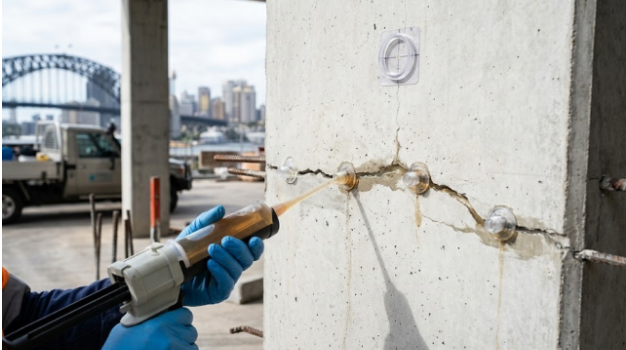
Concrete is strong, durable and widely used across Australian buildings and infrastructure. It is not, however, completely immune to cracking. Small cracks can develop from drying shrinkage, temperature movement, restraint, loading, construction practices and other factors. Some are mainly cosmetic, while others can point to a deeper structural or durability issue.
The important question is not simply, “How do we fill this crack?”
A better question is, “Why did the crack form, what is it telling us about the structure, and will the proposed repair address the actual problem?”
That distinction matters in commercial buildings, car parks, balconies, retaining structures, industrial facilities, bridges and other concrete assets across Sydney. The Concrete Institute of Australia notes that restrained shrinkage and temperature movement can create tensile stresses that contribute to cracking in concrete.
For some stable cracks, injection can form part of a suitable repair strategy. For other cracks, injection alone may only hide the visible symptom while the underlying cause continues.
A crack is evidence, not the diagnosis
A crack in a concrete wall, slab, beam or column does not automatically tell you what caused it. Its location, width, depth, direction, pattern, age and behaviour all provide useful information.
For example, a relatively straight crack running through a concrete element may have a very different cause from a network of fine surface cracks. A crack associated with rust staining or concrete delamination raises different durability concerns from a dry, stable crack in an internal slab.
This is why experienced concrete repair work starts with assessment rather than immediately applying a repair material.
During an investigation, an engineer or specialist contractor may consider:
| What is examined | Why it matters |
| Crack location | Shows which structural or building element is affected |
| Crack direction | Can provide clues about movement or stress |
| Crack width | Helps assess the nature and severity of the defect |
| Crack depth | Indicates how far damage may extend |
| Moisture condition | Important for selecting an appropriate repair method |
| Rust staining | May indicate reinforcement corrosion |
| Concrete delamination | Can indicate deterioration around reinforcement |
| Crack movement | Helps distinguish stable damage from active movement |
| Loading and site conditions | May identify external factors contributing to the defect |
The assessment does not need to become unnecessarily complicated. It needs to answer the right engineering questions before repair work begins.
Why simply filling a crack can fail
A common repair mistake is treating the visible opening as the entire problem.
Imagine a crack that develops because a structural element is experiencing movement. The surface is filled, the finish looks neat and the defect appears to have disappeared. If the movement continues, the repaired area can crack again.
The same issue can occur when moisture ingress, reinforcement corrosion or another deterioration mechanism has not been addressed. The repair material may remain intact for a period, but the concrete around it can continue to deteriorate.
That is why Concrete Crack Injection Sydney services should be considered as part of an engineered repair strategy rather than as a simple cosmetic treatment.
The repair objective needs to be clear first.
Is the purpose to restore continuity through a suitable crack? Reduce water penetration? Protect reinforcement? Improve durability? Restore part of the concrete element’s performance? Or simply seal a surface defect?
Each objective can lead to a different repair approach.
Where epoxy crack injection fits into the repair process
Epoxy injection can be used for suitable concrete cracks where bonding and structural continuity are part of the repair objective. The suitability depends on factors such as crack condition, movement, contamination, moisture and the characteristics of the concrete element.
A properly designed injection system can introduce resin into the crack rather than simply placing material across its exposed surface. The resin needs to reach the relevant crack path, and the injection process must be compatible with the condition of the concrete.
That is one reason epoxy crack injection in Sydney work should be approached as specialist engineering repair rather than a basic filling exercise.
The resin itself is only one part of the process.
Surface preparation, crack assessment, injection ports, sealing, injection pressure, resin selection, curing and post repair inspection all contribute to the result.
PRO TIP
Do not judge an injection repair by its surface appearance alone.
A neat surface does not prove that the crack has been properly treated. The real question is whether the repair method matches the crack’s cause, condition and intended performance.
Stable cracks and moving cracks need different thinking
One of the most important distinctions in crack repair is movement.
A crack that remains relatively stable can potentially be treated using a rigid repair material in appropriate circumstances. A crack that continues to open and close presents a different engineering challenge.
Rigid materials do not accommodate significant ongoing movement in the same way as flexible systems. If a crack is active, the repair strategy may need to accommodate that movement rather than simply lock the two sides together.
This is why a site assessment can be more valuable than a quick visual repair recommendation.
Temperature changes, structural loading, settlement and environmental conditions can all affect crack behaviour. The Concrete Institute of Australia identifies drying shrinkage, carbonation, creep, humidity, temperature changes and applied loads among the factors associated with movement and cracking in concrete structures.
What happens during a professional crack injection repair?
The exact procedure depends on the project, but a properly managed repair commonly follows a logical sequence.
1. Condition assessment
The affected concrete is examined to establish the location, pattern and apparent condition of the cracking. Other visible defects are recorded rather than treating the crack in isolation.
2. Crack preparation
Loose material, dust, contaminants and unsuitable surface material may need to be removed. Proper preparation helps the repair system perform as intended.
3. Injection arrangement
Injection ports or another suitable delivery arrangement may be installed along the crack at appropriate intervals. The arrangement depends on the crack geometry and the selected repair system.
4. Surface sealing
The exposed crack may be sealed between injection points so that the resin can be directed through the intended crack path rather than escaping from the surface.
5. Resin injection
The selected epoxy system is introduced under controlled conditions. The objective is to achieve suitable penetration and bonding without causing unnecessary pressure or damage to the surrounding concrete.
6. Curing and inspection
After curing, the repaired area is inspected and finished as required. Additional testing or monitoring may be appropriate for significant structural repairs.
This process demonstrates why successful injection is not simply a matter of buying epoxy and putting it into a hole.
A useful distinction: sealing, filling and structural repair
These terms are sometimes used interchangeably, but they can represent different repair objectives.
| Repair objective | Main purpose |
| Crack sealing | Reduce moisture or contaminant entry |
| Crack filling | Fill a crack primarily for surface or durability purposes |
| Epoxy injection | Introduce a resin into suitable cracks to achieve the specified repair objective |
| Structural repair | Restore or improve a structural element using an engineered repair strategy |
| Concrete replacement | Remove and reinstate deteriorated or damaged concrete |
| Strengthening | Increase structural capacity or address identified deficiencies |
The correct method depends on the defect and the required outcome.
For significant structural elements, repair decisions should be based on engineering assessment rather than keyword driven assumptions.
When crack injection may not be enough
Crack injection is not a universal answer for every concrete defect.
A crack may be associated with reinforcement corrosion, concrete cancer, inadequate cover, excessive loading, movement, construction defects or other deterioration. In these situations, the visible crack may be only one part of a much larger condition.
For example, if reinforcement has corroded and caused concrete to expand and delaminate, filling the crack without addressing the affected concrete and reinforcement does not deal with the deterioration mechanism.
The same principle applies to structural movement. If the structure continues to move beyond the capacity of a rigid repair, another crack can appear beside or through the repaired area.
This is where services such as structural assessment, concrete repair, corrosion treatment, GPR scanning and forensic investigation can work together.
How GPR scanning can support a concrete investigation
Visual inspection provides important information, but it cannot reveal everything inside a concrete element.
Ground penetrating radar, commonly referred to as GPR, can assist with locating features within concrete and can support investigations where information about reinforcement or embedded elements is required. The Concrete Institute of Australia lists non destructive testing as an established area of concrete practice and notes that such testing methods can provide useful information without destructive intervention.
For a repair project, this can be valuable before drilling, cutting, coring or carrying out other intrusive work.
GPR does not replace engineering judgement. Instead, it can add another layer of evidence to the investigation and help the project team make more informed decisions.
What property owners should record before calling a specialist
Good site information can make the first assessment much more useful.
Take clear photographs from several angles. Record the approximate location of the crack and note when it was first noticed. If the crack has changed, record what changed and over what period.
Look for related signs such as water staining, rust marks, flaking concrete, exposed reinforcement, unusual movement or cracking in nearby areas.
A simple record might include:
- Date the crack was first noticed
- Location within the building or structure
- Approximate crack length and width
- Photographs showing the surrounding area
- Signs of moisture or corrosion
- Previous repairs
- Any noticeable changes over time
- Recent construction, loading or building works nearby
These details can help establish a useful starting point for the inspection.
Australian engineering practice matters
Concrete repair should sit within the broader requirements applying to the structure and project. Standards Australia identifies AS 3600 as the Concrete Structures Standard, with the associated commentary providing guidance on interpretation and application.
The Australian concrete sector also has dedicated guidance covering crack repair. Austroads has published ATS 5341 for the repair of concrete cracks as part of its technical specifications for concrete work.
The relevant documents for a particular project depend on the structure, location, scope and contractual requirements. A competent repair team should be able to work within the applicable engineering and project framework rather than treating every crack as the same defect.
The cost of delaying a concrete crack investigation
Not every concrete crack requires urgent structural intervention. At the same time, ignoring a developing defect can make future repair work more disruptive.
Water can enter cracks and contribute to deterioration. Reinforcement corrosion can lead to expansion and concrete damage. Repeated movement can make previously repaired areas fail again. In a commercial or industrial setting, deterioration can also affect access, operations and maintenance schedules.
The practical advantage of early assessment is not simply about repairing a crack sooner.
It is about finding out what the crack represents before the condition becomes harder to manage.
Questions worth asking before approving crack injection
A property owner, builder or facility manager can ask several straightforward questions before repair work begins:
What is believed to be causing the crack?
A repair recommendation should have a reason behind it.
Is the crack stable or moving?
The answer can influence material and repair selection.
How deep does the crack extend?
Surface appearance alone cannot always establish this.
Is reinforcement affected?
Rust staining, delamination and other signs may require further investigation.
What is the purpose of the repair?
Structural restoration, durability, water control and cosmetic improvement are different objectives.
How will the completed repair be assessed?
A clear inspection process provides better confidence in the finished work.
These questions help shift the conversation from “How much does crack filling cost?” to “What repair does this structure actually require?”
A better approach to recurring concrete defects
The most effective concrete repair projects usually begin with evidence.
Inspection identifies the visible condition. Engineering assessment helps establish the likely mechanism. Testing can provide additional information where the condition cannot be established visually. The repair method is then selected to suit the actual problem.
That process can involve more than injection alone.
A project may require concrete repair, corrosion treatment, structural strengthening, GPR scanning, forensic investigation or monitoring alongside crack repair. The final scope should reflect the condition of the structure rather than forcing every defect into the same repair method.
For anyone researching Concrete Crack Injection Sydney or Epoxy Crack Injection Sydney, that is the key point to remember: the injection material is only one component of a successful repair.
Put the crack in context before putting resin into it
A repaired crack should do more than look better.
It should have a clear repair objective, an appropriate method and a documented reason for the work carried out. For commercial buildings, infrastructure, car parks, industrial structures and other concrete assets, that engineering approach can make the difference between a short term surface fix and a properly considered remedial solution.
If recurring cracking, water ingress, concrete deterioration or structural damage is becoming a concern, Concrete Engineering Solutions can assess the condition and help identify the appropriate engineering pathway. Its specialist services include concrete repair, carbon fibre strengthening, structural strengthening, corrosion treatment, epoxy crack injection, post tension repair, GPR scanning, heavy lifting and monitoring, and forensic investigation.
Start with the condition of the concrete, not the repair product. A site assessment can establish what is happening, identify the evidence that matters and help determine the repair strategy suited to the structure.
Sources and technical reference
This article draws on publicly available Australian industry and standards information from the Concrete Institute of Australia, Standards Australia and Austroads. The Concrete Institute of Australia publishes technical resources and practice notes covering concrete behaviour, non destructive testing and cracking. Standards Australia maintains the Australian Standards catalogue, while AS 3600 is identified as the Concrete Structures Standard.